
DAVOS, Switzerland, Jan. 21, 2026 -- As political and business leaders gather at the World Economic Forum Annual Meeting 2026 in Davos under the theme "A Spirit of Dialogue," a practical question looms large: amid rising geopolitical uncertainty and pressure on global trade and investment, how can the movement of people, commerce, and capital remain efficient and resilient?
According to the International Monetary Fund, global economic growth is expected to moderate in 2026. With advanced economies facing structural headwinds and emerging markets grappling with higher financing costs and friction in cross-border transactions, the foundational capabilities that enable international economic activity—particularly payments—are becoming critical.
Against this backdrop of global economic realignment, UnionPay, one of the world's largest card payment organizations, is focusing on cross-border network connectivity as a practical entry point. Rather than positioning itself as a global payment service provider, UnionPay is innovating to foster an open and inclusive international payments ecosystem—built on multilateral collaboration, interoperability, and shared value. At the same time, it is exploring the responsible application of digital technologies, including artificial intelligence in payments, seeking solutions that offer efficiency, security and financial inclusion.
To date, UnionPay cards are issued in 84 countries and regions globally. Its acceptance network spans 183 countries and regions. Through partnerships with over 2,600 financial institutions and payment stakeholders worldwide, UnionPay has introduced digital payment products and services adapted to local markets, supporting commerce and consumption across contexts.
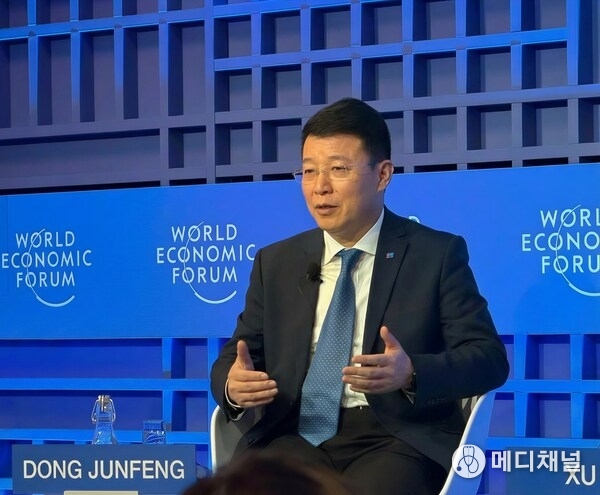
Dong Junfeng, Chairman of China UnionPay and UnionPay International, delivered a speech at a World Economic Forum roundtable discussion. UnionPay's more than two decades of development reflect China's broader trajectory of economic resilience and continued opening-up. Even amid a more complex global environment, UnionPay has remained committed to its international strategy—promoting high-quality development in the payments sector and advancing cooperation frameworks based on equality, mutual benefit, and shared growth.
Connectivity in Practice: Advancing the New Four-Party Model in Emerging Markets
Scaling cross-border payments requires more than technical integration, depending on cooperation models that are sustainable and replicable. In recent years, UnionPay has developed a "New Four-Party Model" for digital payments era through network-to-network (N2N) and government-to-government (G2G) cooperation.
Building on the traditional four-party payments framework, this model expands participation on both sides of the ecosystem. On the account side, it brings in digital wallets and mobile device manufacturers; on the acceptance side, it incorporates payment service providers, payment aggregators, and SaaS platforms. Through bilateral and multilateral collaboration, the model aims to integrate high-quality resources, reduce the cost of cross-border cooperation, and accelerate network expansion.
In practice, UnionPay has applied this approach in Southeast Asia, Central Asia, the Middle East, Africa, and Latin America—key emerging markets—where it is helping to advance interoperability among cross-border QR code payment networks. Importantly, this model is not designed to replace local payment systems. Instead, it operates within existing regulatory frameworks, promoting mutual recognition of standards and coordinated network development, while supporting local efforts to enhance payment infrastructure.
As a result, tens of millions of micro, small, and medium-sized merchants worldwide are connected to UnionPay's inclusive global network, gaining better access to international consumers and cross-border commercial opportunities.
Responsible AI in Payments: Turning Innovation into Practice
Artificial intelligence has been a focal point of Davos discussions, given its potential to reshape economic structures and growth models. Yet in payments—a sector with high security and compliance requirements—the challenge lies in harnessing innovation while effectively managing risk.
UnionPay positions itself as a leading application-driven AI practitioner in the financial sector, treating AI as a new productivity driver to support the intelligent upgrading of payments. Rather than pursuing isolated use cases, it has adopted a collaborative approach, working with technology companies, research institutions, and universities to build a shared AI application ecosystem that supports high-quality and sustainable deployment in financial scenarios.
For payment security, UnionPay has built an intelligent risk-control system that significantly improves the timeliness and effectiveness of transaction protection. AI-generated expert risk rules now achieve an accuracy rate of 85%.
In regard of agentic-based payment solutions, UnionPay is one of the first movers in the industry. Its MCP Agent Payment Service enables users to complete the entire journey from request to payment through conversational interaction.
As China continues to expand visa-free travel policies, UnionPay has also introduced AI-enabled services for inbound visitors. Through its one-stop digital platform—the "Nihao China" app, launched in December 2025—AI is applied to payment guidance, multilingual translation, itinerary planning, and daily life recommendations, offering international travelers a more seamless experience.
From Dialogue to Cooperation: Realizing Long-Term Value in Cross-Border Payments
At its core, UnionPay's practice reflects the spirit of dialogue championed by Davos. By working with local payment systems across markets, UnionPay does not seek to impose a single model or standard, but to find common ground amid diversity—creatively building a more open and inclusive global payments ecosystem.
By improving cross-border payment efficiency and lowering transaction costs, UnionPay supports regional economic circulation and enables broader participation by small and medium-sized players, particularly in emerging markets. This cooperation-first, win-win approach aligns closely with the values repeatedly emphasized by the World Economic Forum in an era of uncertainty.
Looking ahead, UnionPay will continue to use connectivity as a lever to deepen multilateral cooperation and contribute to a more open, inclusive, and sustainable international payments ecosystem—true to its vision of "Trusted Ties, Shared Success."